
Battery Boot Failure: Root Cause & Firmware Fix
By Arjun K Nair
Introduction
Bloom Tulip and Bloom Lily bonding routers are engineered as robust, multi-WAN, battery-powered devices designed to ensure uninterrupted connectivity. These routers integrate multiple LTE modules and a powerful microprocessor, drawing power from either a 12V DC adaptor or an internal rechargeable battery.
This dual power source operation is essential for portability and backup scenarios, but it introduced unexpected complexities during real-world deployments.
The Problem — Invisible Failure
During rigorous field testing, a critical and perplexing issue emerged: the routers worked perfectly when powered by the 12V DC adaptor, but experienced consistent boot failures when operating solely on battery power. The behavior was consistent:
The router functioned flawlessly when plugged into the wall, indicating that the core hardware components were completely operational.
Why It Worked on Adaptor but Not Battery
12V DC Adaptor
- Provides a continuous, high-capacity power supply.
- Can easily handle sudden, massive spikes in current demand without triggering protection circuits.
Battery with BMS
- The Battery Management System (BMS) strictly regulates power output to prevent damage, overheating, or fire.
- It has a hard limit on the maximum allowable current draw. Exceeding this limit triggers an immediate safety shutdown.
Root Cause Analysis
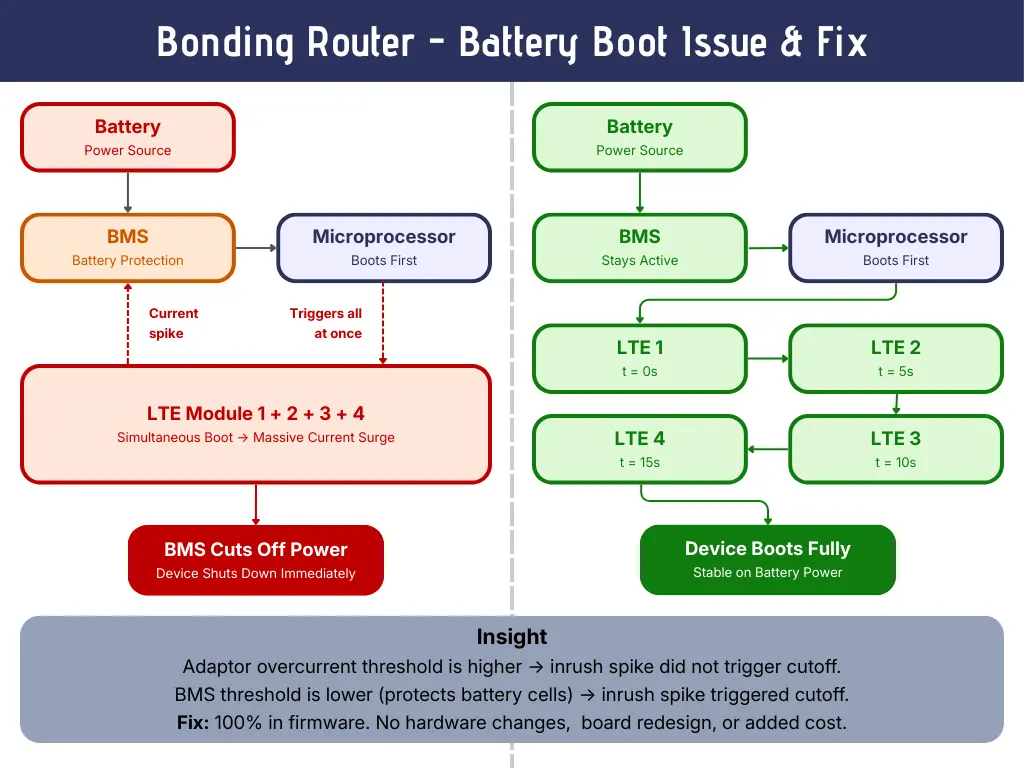
Extensive debugging of the boot sequence revealed a critical flaw in how the system handled power-up events. It wasn't a hardware failure, but rather an issue of timing and peak power demand.
The microprocessor initializes normally.
The firmware sends a command to power on all 4 LTE modules simultaneously.
Each module draws a significant "inrush current" precisely when it powers up.
The combined spike equals 4× the normal inrush current happening in a fraction of a second.
The battery's BMS detects this massive spike as an overcurrent event (a potential short circuit).
The battery instantly shuts off to protect itself, causing the device to fail mid-boot.
The hardware was fine. The issue lay entirely in the firmware's timing configuration.
Bonding Router — Battery Boot Issue & Fix
The Fix
To solve this, engineering had to choose between redesigning the hardware or intelligently altering the firmware.
| Factor | Hardware Approach | Firmware Approach ✓ |
|---|---|---|
| Method | Increase battery capacity and redesign BMS to handle higher current spikes. | Delay the boot sequence of each module. |
| Complexity | PCB changes required | No hardware changes required |
| Regulations | Re-certification required | No re-certification required |
| Cost | Increased BOM cost per unit | Zero additional cost |
| Time to Market | High (Redesign & Re-validation) | Low (Immediate deployment) |
Chosen Solution: Firmware Fix
We rewrote the boot sequence to implement a staggered startup routine:
Result
Key Takeaway
Understanding the intricate interaction between hardware constraints (BMS current limits) and firmware execution (boot timing) is critical. What initially appeared to be a hardware failure was elegantly solved through precise root cause analysis and an optimized firmware timing adjustment, saving substantial costs and development time while delivering a perfectly reliable product.
Download the Full Case Study
Discover how we resolved a critical battery boot failure in our Bloom Tulip bonding routers. This case study explores the root cause analysis of inrush current spikes and the elegant, zero-cost firmware fix that ensured reliable portable operation without hardware changes.
Download the Technical Case StudyPassionate about embedded systems and networking?
Join our team and be part of the Make in India movement.
Explore Careers at Benlycos